
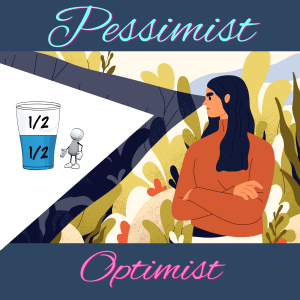
Pessimistic character is one of many traits that are considered to have a negative impact. Almost all of us know that we tend to focus on the negative rather than the positive. Do you think having this personality has a wholly negative impact on us? Do you think it’s wrong to judge a half-empty glass rather than half-full?
Let’s discuss more!
I don’t want to brag about pessimistic characters in this content. On the other side, we must be aware that to turn a situation around, we must be able to imagine the worst-case scenario. Almost everyone who has seen this content has had challenges that make it difficult to think clearly. Of course, your best friends and those around you will try to cheer you up with encouraging words.
Let’s just be honest, did it help you to resolve or at least provide a solution to your problem? No, right? The intentions are great. They make an effort to empathize with you. However, you can’t always accept encouraging phrases and think of them as pure good intentions. Sometimes we become self-centered and believe that “that person doesn’t fully understand what you are feeling and going through.” And the others who do not express sympathy help us sober up and find solutions eventually.
In this context, I’ll explain ‘defensive pessimism,’ which is the good side of pessimism. “Defensive Pessimism” is a strategy for dealing with anxiety, according to “The Positive Power of Negative Thinking.” It can also help us regulate and control our stress so that it does not negatively impact us. I provide examples from several cases to help you understand the concept and learn about defensive pessimism.
The first example is that in this digital era, it is easy to be tempted by tempting offers that can be obtained instantly, right? If someone around you says that company A’s offer was a hoax, many were deceived by them. Wouldn’t you have avoided it, or if you had already accepted their offer, you would have tried as quickly as possible to cut your ties with everything regarding the company, right?
In the second example, there is currently a lot of news, ranging from positive to negative. In your opinion, which information is more interesting to read first? If you hear that the world is going through a crisis A, B, or C vs. the expectation that the world will tend to improve in the future, which news are you more likely to read first? Most of you will choose to read the bad news first. Why?
“People take pessimism more seriously rather than optimism.”
Another example is when we decide to invest, our ultimate goal is to make a handsome profit. However, before we achieve our ultimate aim, we usually focus on other things. Most people prioritize not losing money over growing money. Of course, not everyone thinks this way, but we can’t always predict or control our thoughts. It just happens on its own.
Some of you may not want to completely relate to this content or might feel as if I was attempting to disrespect or criticize you. But that’s fine. I will accept your hatred thoughts as long as you learn something or at least know something.
When we are at a comfortable point or condition, we tend to be lazy to think or explore further, especially about worrying about things that have a low chance of happening. This line resonates with me; I believe it is an illusion of comfort that prevents us from growing.
On the other side, if you are in a situation where you don’t have many options and are placed in a different environment, you may feel terrible and depressed at first, but this will make you grow stronger. Why? You’ll be more open to all possibilities and try to avoid the unpleasant things you’re afraid of. Not only that, but even in that stage, you don’t expect to witness a superb and luxurious finishing process because a speck of light will make you feel like it’s a miracle.
Sometimes you have to lower your expectations or not expect too much because, as you know, “high expectations will not produce good results.” Lowering your expectations for certain things will boost your mental and physical stability. Don’t set unrealistic goals for yourself or your future. Because you never know what will happen next. Low expectations prepare you for failure and push you to strive harder to avoid the negative outcomes you have imagined (Mernutu Noren & Cantor, 1986). According to research, defensive pessimism can also boost self-confidence and life satisfaction, resulting in positive outcomes.
Some tend to associate defensive pessimism with self-handicapping. These two words are very similar in their concept. Both express anxiety for the future, but the difference is that one allows pessimism to influence future outcomes. While the other one does nothing to avoid the worst-case scenario. To summarize, self-handicapping involves self-sabotage, while defensive pessimism involves overpreparation.
Many people say that we need to let positivity flow in us, which makes you sometimes force yourself to be positive and act just fine because you think it’s just our nature to respond that way. Being optimistic is good, but being overly optimistic can also be misleading. A sentence says, “overly optimistic make us open the path to vulnerabilities.” Being too optimistic will also increase your chances of experiencing depression, becoming less realistic, and being more subjective about many things. For this reason, we must not put our expectations of happiness on what we call “annoying features.”
Being negative is not strange. You are allowed to express your feelings, and you deserve every right. You are not a cold, emotionless machine. If you feel it, don’t reject it; accept it and work on it. Don’t force others to welcome you since people will always find their way to tear us down and criticize us no matter what. Be yourself and do what you want.
Your first task is identifying, analyzing, and reflecting on why you frequently think about negative things. Suppose you believe you are a pessimist but have never heard about defensive pessimism. In that case, you can try to practice it, or if you consider yourself to be optimistic, you can try to apply strategic optimism or realistic optimism.
In short, strategic optimism is that you set higher expectations, make sure you keep calm and don’t overwhelm yourself with pressure, and don’t reflect on the situation more than you should. While realistic optimists believe that they will succeed and have to work hard to get that success, the similarity with defensive pessimism is that realistic optimists also put more effort into planning.
That’s all for today’s content. See you on the next content, I really hope that you can learn something from this content and start to see the different perspectives on being a pessimist (if you are a pessimist).
References
- https://www.elearnmarkets.com/school/units/the-psychology-of-money/the-seduction-of-pessimism
- https://deepstash.com/idea/159905/17-the-seduction-of-pessimism
- https://finnick.club/2020/05/11/the-seduction-of-pessimism/
- https://www.medicalnewstoday.com/articles/319899
- https://positivepsychology.com/defensive-pessimism/
- https://www.theatlantic.com/health/archive/2014/09/dont-think-positively/379993/
- https://theconversation.com/the-surprising-benefits-of-being-a-pessimist-91851
- https://www.talkspace.com/blog/being-pessimistic-what-is-pessimism/
 AMKNWORLD
Leave a comment