
Hi everyone,
With only two days left or even a day left for any of you before we say goodbye to 2025, it feels like it’s the right time to pause and reflect.
How was your year? Did you achieve the resolutions you set at the beginning?
For me, 2025 came with two major life decisions. I chose to challenge my parents by ending a work contract that existed because of their connections, and I moved my career into a different field, one that felt unfamiliar, uncomfortable, yet necessary for my growth.
I hope you can wrap up 2025 with positive energy, welcome the unexpected, and be ready to embark on a new journey as well.
In this final article of the year, we’ll take a deeper look at a behavioural pattern called dry begging. Let’s start!
What is dry begging?
Before writing this piece, I had never heard of this term either. But once you understand it, you may realise how often it appears in daily life.
“Dry begging is more obvious than a subtle hint but less obvious than a blatant ask.” — de Llano.
Dry begging is an indirect way of asking for something (such as attention, help, money, or validation) without clearly stating the request. Instead of being honest, the person drops hints, hoping others will notice and respond as they want.
This behaviour is often associated with emotional manipulation, but it usually comes from discomfort with vulnerability. Many people avoid direct asking because it makes them feel:
- Weak or needy
- Afraid of rejection
- As if they’re losing pride or power
A simple illustration:
Dry begging is like looking at someone with sad puppy eyes, hoping they’ll give you something, without barking or asking.

Some cultures value indirect communication as a polite or non-aggressive way to express needs. So, it’s important to note that not everyone who communicates indirectly is dry begging.
On the other hand, indirectness can cause multiple confusions, such as:
- Create tension
- Lead to misunderstandings
- Erode trust
- Make relationships emotionally exhausting
Why do people choose dry begging instead of being direct?
The common reasons include:
- Fear of rejection
- Poor communication skills
- Wanting something without appearing needy
- Testing relationships without asking outright
- Avoiding uncomfortable conversations
- Growing up in environments where direct asking wasn’t encouraged
Common Forms of Dry Begging?
According to therapist Aerial Cetnar, “sometimes people just don’t know how to ask for what they need, and rather hint and be ignored than ask directly and get rejected.”
Common examples of dry begging that exploit emotional pressure:
- Creating Fake Urgency
This creates pressure and obligation rather than honest communication.- Make the HELP signal more obvious.
- Repeated follow-ups.
- Dramatic pauses.
- Making you feel guilty for not responding.
- Exaggerating Vulnerabilities
The goal is to make you change your plans or offer help.- Loud sighs.
- Repeating how difficult life feels.
- Doing this, especially when you’re about to enjoy something.
- Highlighting What Others Receive
- Pointing out gifts, attention, or privileges that others get.
- Hoping you’ll notice and offer the same.
- Passive-Aggressive Remarks
These are forms of an inability to express frustration directly.- Sarcasm
- Silent treatment
- Indirect criticism
The Emotional Impact of Dry Begging
This behaviour actually doesn’t mean to hurt one another, but indirect communication often leads to:
- One person feels unseen or emotionally neglected. While the other person feels accused and confused.
- A “walking on eggshells” dynamic.
- Emotional withdrawal and avoidance.
- Lower relationship satisfaction.
Relationships are not guessing games. No one is a mind reader; we can’t expect anyone to fully understand us if we refuse to speak up and be open about what we need. When communication feels like solving riddles, it drains emotional energy. It creates resentment, especially when people feel “punished” for guessing wrong.
How Dry Begging Shows Up in Different Relationships?
- Romantic relationships: indirect requests for gifts, attention, or grand gestures.
- Friendships: casual complaints to get financial help or favours.
- Workplace: exaggerated stress to push responsibilities onto others.
- Social media: emotionally loaded posts seeking sympathy or validation.
Common Phrases Used in Dry Begging
- “I haven’t heard from you lately.”
It taps someone’s guilt; instead of showing genuine feelings, it stings the other person. - “It must be nice to have a partner.”
It’s a comment wrapped in complaints, hoping the other person empathises with their circumstances. - “Don’t worry about me, I’ll just eat whatever’s left.”
It hints at the sacrifice they’ve made, so the other feels guilty or pity. - “I guess I’ll figure it out myself.”
This statement sends out the signal of “a sense of quitting or pulling back,” because they are feeling alone in the process.”
These statements often carry hidden expectations rather than honest needs.
Dry Begging vs. Narcissism: What’s the Difference?
Dry begging and narcissism can look similar — but the motives differ.
- Narcissism seeks admiration, entitlement, and superiority
- Dry begging is a manipulation tactic that anyone can use
Narcissistic individuals may use dry begging to:
- Drop repeated hints, so the other notices and offers something.
- Publicly express self-pity, to seek validation, compliments, and words of reassurance.
- Exploit empathy, take advantage of people’s generosity to get special treatment, and be taken care of.
- Play the victim, think their condition is worse than anyone else’s, so if they can’t get something, they think, “Why did others have it so easy?”
- Blaming others for not meeting their needs, to make others feel bad, and end up doing what they want.
- Make help feel like your idea, not because they’re asking for it.
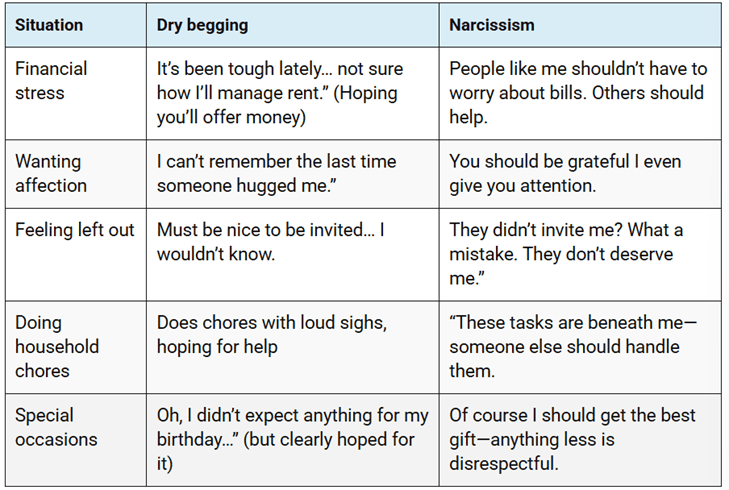
This table illustrates how dry begging and narcissism differ across situations like financial stress, affection, household chores, and special occasions.
Responding to dry begging people?
Shift from tension to curiosity. Create a safe space for clarity. You can ask:
- “Is there something you’re trying to say but finding hard to express?”
- “What are you hoping I’ll do for you?”
- “Do you want help, or are you just sharing how you feel?”
- “Do you mean, you want me to..?”
These questions put the spotlight back where it belongs without being aggressive or defensive. After those who dry beg deliver clarification, it’s your turn to decide. Also, you don’t have to feel bad about rejecting or accepting, because you are not obligated to do something just because they dropped hints or said their needs.
Messages for dry begging people
Being direct doesn’t mean being rude.
Asking clearly doesn’t make you bossy. Others still have the right to say no, so be open to hearing any response. You can also be direct without being harsh.
Notice your patterns
Ask yourself:
- What makes it harder to ask directly? What am I afraid of?
- Am I avoiding a discomfort situation?
- What do I actually need from people (help, money, attention, reassurance)?
Practice Being Direct
When you want or expect to get something, don’t just give a vague or ambiguous answer. Asking for help also costs you nothing, and it’s definitely not going to reduce your “coolness,” so it’s okay to be direct.
Practice by using “I” statements:
- “I need help with…”
- “I would appreciate it if…”
Befriend Rejection
I know it’s uncomfortable to experience rejection. Sometimes, we might think that the person who rejects us has a problem with us. But in reality, many rejections aren’t intended to attack someone’s character or identity. Most of the time, it simply means the other person can’t give you what you want or isn’t in a position to help.
Last but not least…
As we wrap up 2025, I hope this article helps you step into 2026 with more courage, the ability to communicate more transparently, healthier boundaries, and less emotional guessing.
“Being honest about your needs isn’t demanding, it’s respectful for both who says and who listens.”
See you in 2026, and Happy New Year in advance! 🎉🫶
References:
- Gupta, S. (2025, August 20). Why “Dry begging” is a red flag in your relationship. Verywell Mind. https://www.verywellmind.com/dry-begging-in-relationships-11792421
- Center, B. a. C. (2025, July 13). Understanding dry begging: recognize the signs and respond effectively. Bay Area CBT Center. https://bayareacbtcenter.com/dry-begging-recognize-and-respond-to-indirect-requests-in-relationships/#:~:text=Dry%20begging%20refers%20to%20the,into%20providing%20what%20they%20desire.
- Kessler, O. (2025, July 3). What is Dry Begging? Signs & How to Respond. Marriage Advice – Expert Marriage Tips & Advice. https://www.marriage.com/advice/communication/what-is-dry-begging/
- Travers, M. (2025a, June 17). 2 Ways ‘Dry begging’ Harms Your relationship, by a psychologist. Forbes. https://www.forbes.com/sites/traversmark/2025/06/17/2-ways-dry-begging-harms-your-relationship-by-a-psychologist/
- Broadwater, A. (2025, June 16). 6 Subtle ‘Dry begging’ phrases people use to manipulate others, psychologists warn. Parade. Retrieved December 29, 2025, from https://parade.com/living/dry-begging
- Kalt, M., MD. (2025, June 11). Fishing for Favors: How you get hooked into helping. Katie Couric Media. https://katiecouric.com/lifestyle/relationships/dry-begging-meaning/
- Fike, A., & Fike, A. (2025, June 9). Your partner might be ‘Dry begging’ you without realizing they’re doing it. VICE. https://www.vice.com/en/article/your-partner-might-be-dry-begging-you-without-realizing-theyre-doing-it/
- Hurwitz, C. (2025, May 12). Dry begging. Oprah Daily. https://www.oprahdaily.com/life/relationships-love/a64620324/what-is-dry-begging/
- Sneha. (2025, May 9). Dry Begging: What it means and why it happens. Mindtalk. https://www.mindtalk.in/blogs/understanding-dry-begging-psychology-behind-indirect-requests
- Dashnaw, D. (2024, December 12). What is Dry Begging? — Daniel Dashnaw. Daniel Dashnaw. https://danieldashnawcouplestherapy.com/blog/what-is-dry-begging
- Blogier, A. (2024, November 24). 9 ways a narcissistic person uses “Dry begging” to get what they want without asking. YourTango. https://www.yourtango.com/self/narcissistic-person-dry-begging-get-what-want-without-asking


Leave a comment