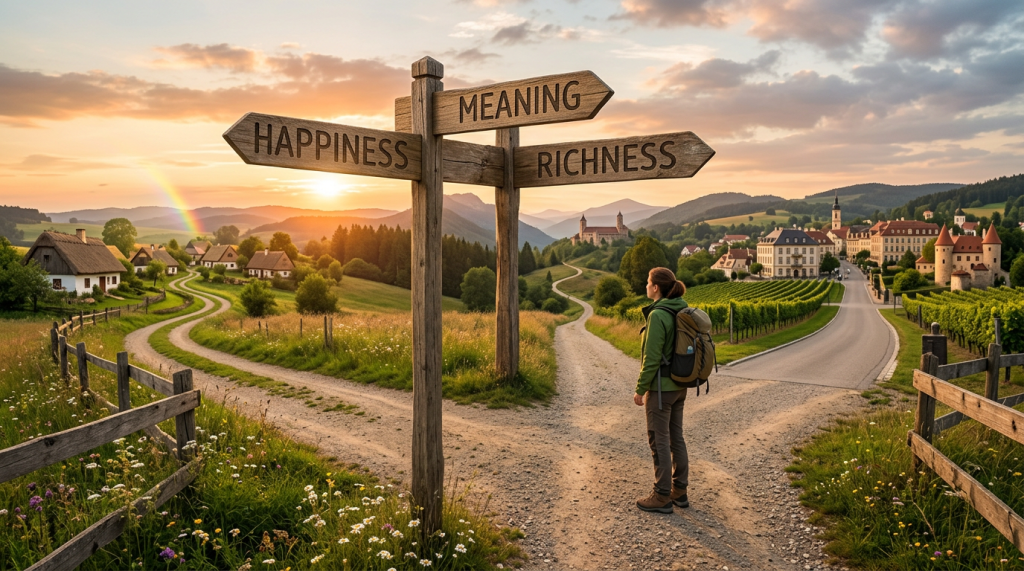
Happiness Isn’t the Only Goal Worth Chasing
Many of us grow up believing that a good life is all about either pursuing happiness or searching for purpose. On one hand, we might focus on comfort, stability, and those moments that bring us joy and peace. On the other, we might look for meaning by making a difference or contributing to something bigger than ourselves. While these paths are familiar and often feel safe, they both tend to keep us within the boundaries of what we already know.

But research by cognitive scientist Shigehiro Oishi suggests another way to think about well-being: psychological richness. Instead of only asking whether our lives are happy or meaningful, psychological richness encourages us to consider a different question altogether.
The Regret Test: “Would I Regret Staying?”
One of the simplest ways to evaluate the impact of a life decision isn’t asking whether it will make you happier. Instead, ask yourself: “Would I regret it if I don’t try this?”
When people reflect on their lives, they often discover that their deepest regrets aren’t the mistakes they made or the path they chose. More often, people regret the risks they weren’t willing to take and the paths they never chose, such as:
- The city they dreamed of moving to but never did.
- The relationship they were too afraid to pursue.
- The business they wanted to start but kept postponing.
Surprisingly, failure usually fades with time. Regret from inaction often doesn’t. Psychologists have mentioned that missed opportunities tend to leave a deeper cognitive mark and emotional imprint than failure, because they represent stories that were never given a chance to unfold.
In a 2020 study on life regrets, researchers asked participants how their lives might change if they could erase their biggest regret. The results revealed something fascinating: around one-third believed removing their regret would have made them happier, one-third believed it would have given their lives greater meaning, and the remaining participants believed it would have made their lives psychologically richer.
This finding reinforces an important insight:
Not every difficult decision is about maximizing happiness. Sometimes it’s just about preventing your life from becoming smaller or duller than it could have been.
The next time you find yourself asking, “should I stay or should I go?”
Try replacing it with another question: “Will I regret it if I’m not doing this?”
Psychological Richness Begins Outside Your Comfort Zone
Growth rarely happens inside routines that never challenge us.
Our brains naturally prefer what’s familiar because familiarity feels safe. Our nervous system has wired each one of us to conserve energy and avoid unnecessary risks. As a result, we often repeat the same habits, visit the same places, interact with the same people, and make the same decisions, just because it feels safe. This phenomenon is known as familiarity bias.
The more stressed we become, the stronger this bias grows. During uncertain times, we instinctively cling to what we already know. But chasing psychological richness asks us to move in the opposite direction from what feels familiar.
One strategy proposed by psychologists is the “take a dozen” rule.
Before making an important decision, whether choosing a partner, accepting a job, renting an apartment, or even settling on your favorite café, give yourself permission to explore at least 12 options first. The goal isn’t perfection. The goal is expanding your perspective before committing.
Research shows that we often underestimate how enjoyable simple interactions with strangers can be. A brief conversation with someone new often leaves us feeling more connected and energized than we expected. For many of us, especially if we are introverts, this can feel overwhelming at first. But once you find the spark, every unfamiliar conversation, experience, or environment adds another layer to our understanding of ourselves and the world around us.
Stepping outside your comfort zone doesn’t always require dramatic adventures. Often, psychological richness begins with something as simple as saying yes to an invitation, trying a new hobby, taking a different route home, or having a meaningful conversation with someone you’ve never met before.
Small moments of exploration often become the stories we pass down through generations.
Embrace the “Good Bad Experiences” That Help You Grow
Most people spend their lives trying to avoid discomfort, failure, heartbreak, or uncertainty. It’s understandable we naturally want to protect ourselves from pain.
But one of the most powerful ideas behind psychological richness is that not every difficult experience is bad. Some experiences may feel painful and uncomfortable in the moment but teach us valuable lessons over time. Losing a job, experiencing rejection, facing illness, ending a relationship, or making mistakes can feel devastating when they happen. Yet these moments often become turning points that reshape our beliefs, priorities, and identity.
Instead of simply causing suffering, they encourage what psychologists call cognitive restructuring, the process of rebuilding the way we think after our previous assumptions no longer fit reality.
In other words, challenges don’t just test us. They can transform us.
Changing how you interpret life is one actionable step if you want to seek psychological richness. To respond well to difficult experiences, we need to adapt and understand this mindset:
An analytic mindset looks for one direct cause behind every problem. It asks questions like:
- “Who is to blame?”
- “What went wrong?”
- “Why did this happen?”
While this perspective can be useful, it sometimes oversimplifies life’s complexity.
A holistic mindset, on the other hand, recognizes that life is interconnected. Success and failure, joy and sorrow, certainty and uncertainty often exist side by side. Instead of seeing setbacks as isolated failures, a holistic perspective asks:
- “How might this challenge prepare me for something I cannot yet see?”
This subtle shift creates room for personal growth. It might look like this:
- A career setback may eventually lead you to a job that better aligns with your strengths.
- A painful breakup may teach you healthier relationship patterns.
- A failed project may become the beginning of a more fulfilling opportunity.
As philosopher Friedrich Nietzsche said, adversity is not simply an obstacle; it is often one of life’s greatest teachers.
Research has even shown that people who endure significant hardships may report lower levels of immediate happiness. Yet many also develop stronger resilience, greater empathy, and a deeper appreciation for their communities and relationships.
Pain doesn’t automatically make us wiser. But when we choose to reflect on difficult experiences rather than simply survive them, they can become some of our greatest sources of wisdom.
Why Being a Generalist Can Make You Smarter and More Adaptable
Modern society often celebrates specialization. People tend to encourage us to become experts in one subject, master one skill, and build careers around a single area of expertise. We all know that specialization has its advantages. It helps us develop professional credibility and deep knowledge.
However, there’s a hidden downside.
When we spend too much time focusing on one field, our thinking can gradually become narrower. Research has mentioned that highly specialized individuals often become less curious about subjects outside their expertise. Over time, they unintentionally limit their exposure to new ideas, perspectives, and creative connections.
Psychological richness thrives on the opposite. That doesn’t mean abandoning our careers or becoming experts in everything. Instead, it means giving ourselves permission to remain curious.
- Take a cooking class, even if you only like to bake a cake.
- Learn a new language.
- Volunteer in a different environment.
- Read about history if you work in technology.
- Study psychology if you’re an engineer.
- Practice “one week sabbaticals”; stay in different departments to serve as an antidote to a one-dimensional life (if possible).
The goal isn’t productivity. It’s expanding the range of experiences your mind can draw from.
Curiosity Prevents Routine from Becoming Stagnation
Even if you’ve spent years mastering one subject, being curious can keep your work feeling fresh and prevent burnout.
The reference gives us a well-known example: legendary sushi master Jiro Ono, who has devoted decades to perfecting sushi. Rather than repeating the exact same process every day, he continuously experiments with tiny improvements: adjusting techniques, refining ingredients, and testing subtle variations.
One famous example involves extending the massage time for octopus from 30 to 45 minutes to achieve better texture. To outsiders, the difference may seem insignificant. To someone committed to lifelong learning, it’s another opportunity to discover something new.
So, instead of asking, “how can I finish this faster?” ask, “what can I learn by doing this differently today?”
Live Thousands of Lives Without Leaving Home
One of the biggest misconceptions about psychological richness is that it requires constant travel, expensive adventures, or an extraordinary lifestyle. But no. In reality, some of the richest experiences happen without even boarding a plane. Through books, memoirs, documentaries, and literary fiction, we can experience perspectives we could never access through our own lives alone.
Psychologists refer to this as a vicarious experience.
When we immerse ourselves in another person’s story, we temporarily step outside our own worldview and begin seeing life through someone else’s eyes. This process develops what researchers call attributional complexity, the ability to recognize that people’s thoughts, decisions, and behaviors usually have multiple causes rather than a single explanation.
Instead of relying on stereotypes or quick judgments, we become better at understanding nuance.
- We learn empathy.
- We become more open-minded.
- We develop greater emotional intelligence.
Reading literary fiction, biographies, or memoirs can be especially valuable because these stories present characters as complex human beings rather than one-dimensional heroes or villains. Each story expands the mental library we use to interpret real life.
As a Moroccan bookseller once beautifully said: “He read 4,000 books, so he lived 4,000 lives.” In the end, that is the promise of psychological richness: the more widely you live, learn, and imagine, the more fully you can understand your own life.
Whether or not the quote is literally true, its message is powerful. Every meaningful story you consume becomes another life you’ve briefly experienced. And each new perspective adds another layer to your own psychological richness.
Stop Chasing Thrills. Start Collecting Stories.
What differentiates sensation seeking vs. Psychological Richness?
Psychologists describe sensation seeking as the desire for increasingly intense stimulation. The excitement fades quickly, creating a cycle where people constantly need something bigger, newer, or more thrilling just to feel the same level of excitement. It’s a temporary high.
Psychological richness means you are collecting perspectives. Each meaningful experience, whether joyful, challenging, surprising, or even uncomfortable, becomes part of a story that shapes who you are today.
Rather than asking, “what’s the next exciting thing I can do?” ask yourself, “what kind of story is this experience helping me write?”
Over time, these experiences become an emotional and intellectual investment portfolio, one that continues to grow long after the moment itself has passed.
How do we turn Experiences Into Wisdom?
The answer is: an experience alone doesn’t automatically create personal growth. Reflection does.
After a meaningful experience, spend time writing about it. Describe what happened, how you felt, what surprised you, and how your perspective changed. Then, when you feel it’s okay, share that story with someone else.
Writing helps organize your thoughts, while storytelling helps deepen your understanding. Together, they allow you to revisit experiences with greater clarity and uncover lessons that may not have been obvious in the moment. Think of it as creating a collection of psychological memorabilia.
Instead of only boosting your achievements, you also preserve the moments that challenged you, stretched your beliefs, and changed your outlook on life. Even painful chapters deserve a place in your story, not because they define you, but because they reveal how you’ve grown from them.
Just as financial wealth can be passed from one generation to the next, the stories we tell can become a form of psychological wealth for our next generation. By doing that, we emphasize that life isn’t simply about winning or losing. It’s about learning, adapting, and discovering new ways to understand ourselves and the world around us.
Conclusion
Three dimensions of a flourishing life:
- Happiness gives us joy, comfort, and emotional well-being.
- Meaning gives us direction, purpose, and a sense of contribution.
- Psychological richness gives us curiosity, perspective, adaptability, and wisdom.
These dimensions don’t compete with one another. They complement one another. Some seasons of life may be filled with happiness. Others may revolve around purpose. Still others may challenge us in ways that expand our understanding of ourselves and the world.
Each season has something valuable to offer. The goal isn’t to maximize one at the expense of the others. The goal is to live a life that is emotionally fulfilling, deeply meaningful, and intellectually rich.
The Question That Could Change Your Life
We often question our decisions long after we have chosen a different approach or made a decision. How often do we find ourselves asking, “Why didn’t you?” after we regret it? That question is powerful because it shifts our attention away from excuses and toward possibility.
- How many opportunities have we postponed because they felt uncertain?
- How many dreams have we delayed while waiting for the “perfect” moment?
- How many conversations, career moves, creative projects, or relationships have we avoided simply because staying where we are felt safer?
Sometimes, the greatest risk isn’t trying something new. It’s because we are scared of the uncertainty, afraid of the unknown, not because what we are contemplating is wrong, but just feels unfamiliar.
If you want to aim for psychological enrichment, ask yourself a different question today: “Will I regret it one day if I don’t take this chance?”
A meaningful life isn’t measured solely by how often you smile. Nor is it measured only by how productive or successful you become. It’s also shaped by the people you meet, the challenges you overcome, the books you read, the conversations that change your perspective, and the moments that redefine who you are.
You don’t need to travel the world or completely reinvent your life to become psychologically richer. Sometimes, all it takes is saying yes to something unfamiliar, learning one new skill, reading one life-changing book, even having one honest conversation with strangers.
Don’t rush. One decision at a time. In the end, the richest lives aren’t those with the fewest problems. They’re the ones filled with stories worth remembering, lessons worth sharing, and perspectives that continue to grow.
So the next time fear tells you to stay where it’s safe, pause for a moment and ask yourself:
“Well… why don’t I try?”
What do you think? I’d love to hear your story, your perspective, even your ideas. If you enjoyed this article, consider sharing it with someone who needs a gentle reminder that “life is not only about being happy and living a meaningful life.” See you in the next article!
References
- 10 lessons of psychological richness. (2025, February 3). BPS. https://www.bps.org.uk/psychologist/10-lessons-psychological-richness
- Alliant University. (2026, July 2). “Life in Three Dimensions”: The Power of Psychological Richness | Wellness in Today’s World | EP 19 [Video]. YouTube. https://www.youtube.com/watch?v=WZj2UjVYKmk
- American Psychological Association. (2025, May 28). How to create a psychologically rich life [Video]. YouTube. https://www.youtube.com/watch?v=OoT11vqua6k
- Oishi, S., & Westgate, E. C. (2021). A psychologically rich life: beyond happiness and meaning. Psychological Review. https://www.apa.org/pubs/journals/releases/rev-rev0000317.pdf
- unSILOed Podcast with Greg LaBlanc. (2025, April 30). 532. Beyond Happiness: Delving into Psychological Richness feat. Shigehiro Oishi [Video]. YouTube. https://www.youtube.com/watch?v=jfDdxrMlZaE


Leave a comment