
Hi all, it’s been a while since I uploaded anything. I’m not trying to defend myself for the sudden change in my life, and I decided to study language in a country I’ve never even visited before, so getting used to everything and finding the right pace is kinda challenging. Hopefully I can get back on track like I usually do before all the changes. Without more intermezzo, let’s start.
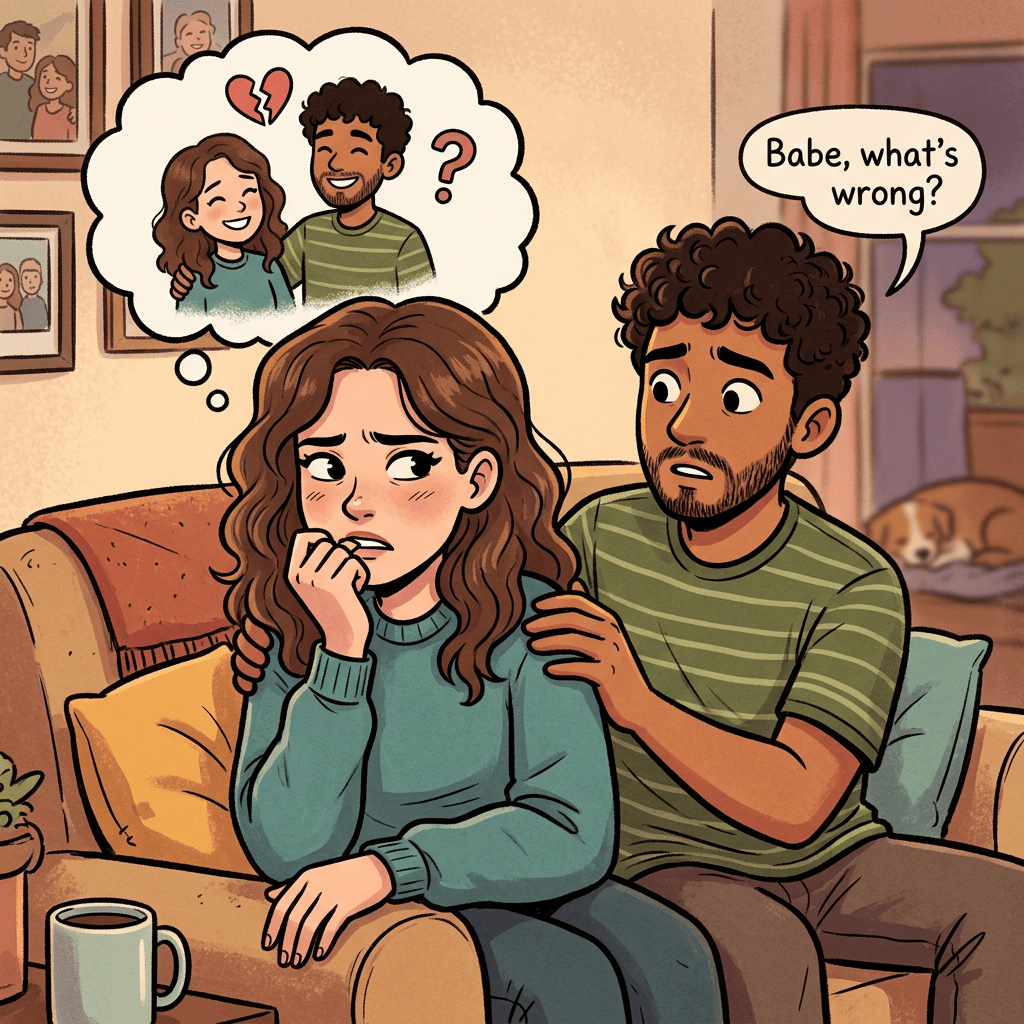
Your partner is laughing. Maybe nothing is wrong. Maybe you’re having a perfectly normal day. And then, out of nowhere, an image enters your mind. An intrusive image creeps in.
You imagine your partner laughing with their ex in exactly the same warm way they laugh with you. You picture them sharing an inside joke, celebrating something together, walking somewhere hand in hand. Suddenly, you find yourself wondering:
- “Did he/she treat their ex the way they treat me?”
- “Were they happier with them?”
- “What did their relationship have that mine doesn’t?”
The painful part is that you may not have seen anything that actually triggered these thoughts. Your mind simply wandered into the past, and suddenly, you’re emotionally living inside a relationship that ended long before yours began.
You start comparing your appearance, personality, career, experiences, or worth to someone you’ve never even met. You replay scenarios you weren’t there to witness. You search for details that might give you certainty.
And somehow, the more you think, the worse you feel.
If this sounds familiar, you may be experiencing retroactive jealousy.
The term retroactive jealousy isn’t a formal clinical diagnosis. It is a popular term used to describe intense emotional distress surrounding a partner’s romantic or sexual history. For some people, it can involve anxiety, sadness, anger, insecurity, shame, intrusive thoughts, and repeated attempts to seek reassurance.
And although the relationship happened in the past, the emotional reaction is happening right now.
Understanding why that happens is the first step toward changing the pattern.
Your Nervous System Doesn’t Have A Calendar
Before your logical mind has time to explain what you’re feeling, before you have the language to verbalize it, your nervous system is already responding.
Its job is simple: detect potential danger and help keep you safe.
The problem is that emotional safety doesn’t always follow the same timeline as rational thinking.
You can consciously know that your partner’s previous relationship happened years ago. You can know that the person is no longer part of their life. You can even know that the scenario you’re imagining never actually happened.
Yet your body can still react as though something important is being threatened.
- Your chest tightens.
- Your heart starts racing.
- Your breathing becomes shallow.
- You feel restless, angry, sad, or suddenly desperate for an answer.
Your mind says: “This happened in the past.”
Your nervous system responds: “But what if it means something about us now?”
This is one reason intrusive thoughts can feel so convincing. The emotional response itself can make the imagined scenario feel important, even when no present-day evidence shows you’re in danger. When you feel uncomfortable, your body can even activate the fight-or-flight response, like someone who thinks a battle for emotional survival is like trying to solve a threat that has already passed, or, sometimes, a threat that never existed outside your imagination.
The goal isn’t to shame yourself for reacting. It’s to learn how to distinguish a feeling of threat from an actual threat.
The Reassurance Trap: Why Knowing More Can Make You Feel Worse
When anxiety appears, the mind naturally wants certainty.
So you ask questions, then another question, then another.
You might find yourself:
- Repeatedly asking your partner for detailed information about their previous relationship.
- Looking through an ex’s social media accounts (if you know it, or you are trying to find it).
- Checking your partner’s phone or questioning their honesty.
- Comparing your appearance, personality, career, or relationship to their previous partner.
- Avoiding restaurants, songs, locations, or activities associated with your partner’s past
- Mentally replaying whatever information you’ve already learned.
At first, these behaviors can feel helpful. You get an answer. Your anxiety drops. For a few minutes or perhaps a few hours you feel calmer. But then another question appears. And you need another answer.
Your anxiety drops.
This is where reassurance seeking can become a trap.
Retroactive jealousy is not itself classified as OCD. However, some people experience patterns that resemble obsessive-compulsive processes: intrusive unwanted thoughts followed by repetitive behaviors intended to reduce distress.
The problem is that reassurance often provides only temporary relief.
If your underlying fear is: “What if I’m not enough?”
Then no amount of information about an ex can permanently answer that question.
- You can learn what they looked like.
- What they did together.
- Where they went.
- How long they dated.
- What your partner liked about them.
- What happened between them.
But every new detail gives your imagination another image to replay. Instead of eliminating uncertainty, you may accidentally give your anxious mind more stuff to dealing with.
And that’s why knowing more doesn’t necessarily make you feel safer. Sometimes, it simply makes the story more vivid, which slowly makes you anxious.
You’re Fighting an Idealized Fantasy, not a Real Person
One of the hardest truths about retroactive jealousy is that the person you’re comparing yourself to may not be the real problem. You may be fighting an idealized version of them that exists in your imagination.
You may be fighting an idealized version of them that exists primarily in your imagination.
When your partner’s past contains information you don’t know, your mind fills in the blanks with your own narratives. And someone with insecure minds rarely fills those blanks with good things.
It tends to create a story in which the ex was:
- More attractive.
- More exciting.
- More confident.
- More compatible.
- More sexually experienced.
- More loved.
- More unforgettable.
Meanwhile, you become the person who has to somehow compete with this imaginary main cast that you choose and the storyline you build. This can be especially painful when you carry underlying vulnerabilities such as low self-esteem, attachment anxiety, rejection sensitivity, or fear of abandonment.
The deeper fear may not actually be: “I hate that my partner had an ex.”
It may be: “What if they experienced something with that person that they will never experience with me?”
Or even: “What if they eventually realize that I wasn’t enough?”
This cycle creates a destructive self-fulfilling prophecy. Makes you who experienced this to lash out at your partner for having a history, creating tension and emotional distance that pushes your partner away. All the accumulates frustration into “believing that you are pathetic, needy, and unstable.”
Here is what we need to believe, “a truly special relationship must be completely unique and untouched by anything that came before it.” Relationships don’t become meaningful because they are someone’s first. They become meaningful because of what two people choose to build together.
Your partner having loved someone before you doesn’t automatically make what you have together less real. And trying to erase their history won’t make your relationship more special either.
When Jealousy Creates the Distance You Fear
There is another painful paradox or way of thinking, “the more frightened you become of losing your partner, the more you may behave in ways that create tension between you and your partner.”
You interrogate, you accuse, you withdraw, repeatedly seeking reassurance, become hypervigilant about small changes in their behavior.
While your partner feels distrusted, you sense their frustration, their frustration makes you more anxious, and suddenly, the fear of rejection creeps in and starts creating emotional distance you were trying to prevent.
This doesn’t mean your feelings are not valid either, it means feeling and behaviors are different. You are allowed to feel jealous, to feel insecure, to have intrusive thoughts. But you are responsible for what you do, and how you choose to react with those feelings. Healing begins when you stop treating every anxious thought as an instruction.
Social Media and AI Can Easily Turn Your Insecurity into an Echo Chamber
Nowadays, many relationships begin and develop in the digital environment. Social media gives us an image of other people’s relationships. But many of us forget that what is shown to the outside world is often the “good” part, and that it shows the “less” complicated part of being in a relationship itself. Sometimes relationship forums can help broaden your perspective, but don’t rely on them alone.
When you are anxious about your own story, and you get extra information from outsiders, it can backfire and make you compare someone else’s relationship to yours. While reading about a cheating partner, you also start looking for clues in your own partner, watch a video about “red flags”, and suddenly question your partner’s behaviour (even though it usually feels harmless). Then, as the anxiety grows, you ask the forums or AI for reassurance. And that’s when your real relationship starts to crack, and there’s no obvious reason behind it, and it’s definitely not fair to your partner either.
That’s the downside of the technology; digital reassurance can become another form of reassurance seeking. They will defend you no matter how wrong your thoughts are, and even though we know it’s just a built-in system and integrated technology, part of us still longs to be understood, to be assured. If you keep using AI to find proof that what your partner does is wrong, eventually you’ll treat their past as a threat, and you’ll defend yourself by saying, “Being anxious about something means there’s gonna be something to back up that.”
Technology can’t replace or simplify the complexity of a real relationship. And sometimes, the healthiest answer isn’t about obtaining more and more information, but about learning to tolerate not knowing.
Stop Investigating the Story, Start Listening to The Fear
Breaking the cycle of retroactive jealousy doesn’t require you to convince yourself that your partner’s past doesn’t matter. It requires you to stop treating the past as a problem you can solve through investigation. The next time you feel the urge to ask another question or check another profile, try these three steps:
The next time you feel the urge to ask another question or check another profile, try these three steps.
Stop Interrogating
- When you feel the sudden urge to ask for another detail, pause.
- Don’t immediately send the message.
- Don’t start the argument.
- Don’t open the ex’s social media profile.
- Give the urge, time to rise and fall without obeying it.
You aren’t ignoring your feelings. You’re learning that discomfort doesn’t require immediate action.
Focus on What Your Body Is Telling You
Instead of immediately asking, “What does this mean?”, ask:
“What am I feeling in my body right now?”
- Notice the tightness in your chest.
- The racing heartbeat.
- The tension in your stomach.
- The shallow breathing.
- The tears you are trying to hold back.
Stay with the physical sensation without immediately turning it into a story about your partner. A feeling is real. But the story your anxious mind attaches to that feeling may not be.
Practice Vulnerability Instead of Accusation
There is a huge difference between saying:
“Why did you do that with your ex? Do you still think about them?”
and saying:
“I’m having a difficult moment. I know your past is your past, but something about it triggered an insecurity in me, and I’m struggling with the fear that I won’t be enough.”
The second sentence doesn’t demand that your partner erase their history. It invites them into your present. Sometimes admitting that you feel vulnerable, is inviting your partner into your present. So, you are not stuck in “imaginary story” that you created alone.
And sometimes, the most honest sentence you can say to yourself is:
“I’m not actually angry. I’m terrified that I won’t be enough for you.”
That may feel vulnerable. But vulnerability is often more healing than interrogation.
Ask Yourself: What If the Worst Outcome Happens?
When intrusive thoughts become overwhelming, try asking yourself a different question:
“If my worst fear actually happened, what would I do?”
- Maybe you fear your partner could eventually leave.
- Maybe you fear being hurt.
- Maybe you fear discovering something you didn’t want to know.
You don’t have to convince yourself that none of these things could ever happen. But you need to remind yourself that you can survive uncertainty. Your emotional safety cannot depend entirely on guaranteeing that another person will never hurt you. That guarantee doesn’t exist.
You need to remind yourself that you can survive uncertainty. Your emotional safety cannot depend entirely on guaranteeing that another person will never hurt you. That guarantee doesn’t exist.
Real security comes when you admit “Whatever happens, I will be able to face it. My partner’s ex belong to their history, and I’m the part of their present, and even their future.”
References:
- O’Sullivan, F. (2026, October 3). Retroactive jealousy: Why their past torments you. Fiachra “Figs” O’Sullivan, LMFT. https://empathi.com/blog/retroactive-jealousy/
- Thompson, B., PhD. (2026, June 2). “Retroactive jealousy” or OCD? Taking a critical eye to an internet label. Psychology Today. https://www.psychologytoday.com/us/blog/anxiety-in-context/202605/what-is-retroactive-jealousy-and-is-it-really-ocd
- Gupta, S. (2026, April 15). Retroactive jealousy causes characteristics and coping (S. Gans,MD, Ed.). Verywellmind. https://www.verywellmind.com/retroactive-jealousy-causes-characteristics-and-coping-6361492
- Clinic, C. (2024, July 19). Jealous of your partner’s past? Here’s why retroactive jealousy stings. Cleveland Clinic. https://health.clevelandclinic.org/retroactive-jealousy


Leave a Reply